

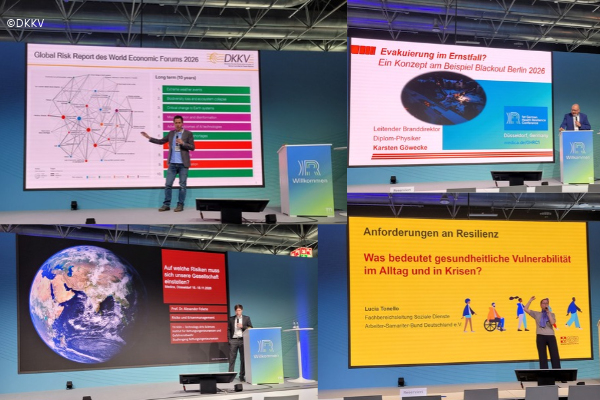
From 16 to 19 November 2026, the first German Health Resilience Conference (GHRC) is taking place as part of MEDICA in Düsseldorf. The conference brings together stakeholders from healthcare, politics, civil protection and disaster management, the armed forces, welfare organisations and academia to develop practical approaches to strengthening the resilience of the healthcare system. Key topics include the protection of critical infrastructure, the provision of medical care during crises and disasters, and preparing hospitals for exceptional emergency situations.
The German Committee for Disaster Preparedness (DKKV) is represented at the conference by its Managing Director, Dr. Benni Thiebes. In his presentation, “What Level of Resilience Is Desirable and Acceptable?”, he explores which protection objectives are necessary and socially acceptable for civil protection and critical infrastructure. His contribution focuses on ways to strengthen resilience and the importance of targeted risk communication. Prof. Dr. Alexander Fekete from TH Köln is also contributing an expert presentation. As a member of the DKKV, he addresses the risks that society needs to prepare for. The conference was moderated by Benno Fritzen, former head of the Münster Professional Fire Brigade.
Alongside the expert discussions, practical tools for strengthening societal resilience are also being presented. One example is the “Gemeinsam resilient” methodology toolkit introduced by the German Workers’ Samaritan Federation (ASB). It was developed in cooperation with Bielefeld University of Applied Sciences and the Disaster Research Unit at Freie Universität Berlin. The toolkit supports individuals and communities in actively engaging with disaster preparedness and self-protection. Comprising 60 method cards and supplementary materials, it offers practical ways to share knowledge, strengthen social cohesion and develop collective approaches to responding to crises.
The conference highlights that a resilient healthcare system can only be achieved through cooperation between different stakeholders and institutions. Exchange between healthcare providers, disaster management organisations, policymakers and researchers is essential to identifying risks at an early stage, improving preparedness structures and ensuring the provision of medical care during crises and disasters.
Further information about the conference and its programme can be found here.