

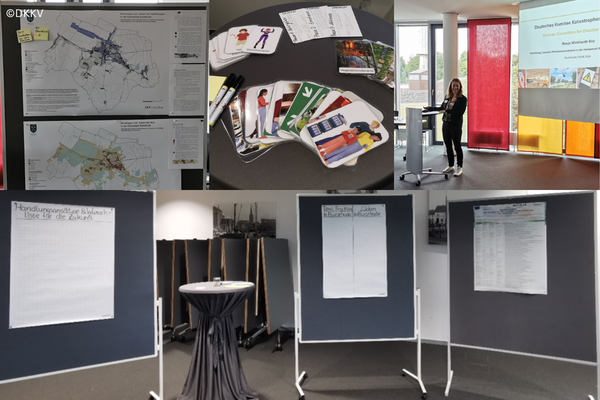
How can warnings, information, and preventive measures be designed to reach everyone? This question was the focus of the expert dialogue “How Can We Make Risk Communication in the Hanseatic City of Buxtehude More Inclusive?,” which took place on August 19 at the Buxtehude Town Hall.
The event was organized by the DKKV as part of the Erasmus+ project RESILIENT VOICES, in collaboration with the pilot municipality – the Hanseatic City of Buxtehude. The project’s goal is to better incorporate the perspectives of vulnerable population groups into disaster preparedness and to make risk communication more inclusive.
The expert dialogue brought together representatives from local government, social services, academia, aid organizations, and self-advocacy groups. Participants included, among others, the Hanseatic City of Buxtehude, Lebenshilfe Buxtehude, VHS Buxtehude, Hochschule 21, the THW, the fire department, the German Red Cross (DRK), the German Life Saving Association (DLRG), the Malteser, the police, as well as resident representatives and other local stakeholders.
Following the opening remarks, the RESILIENT VOICES project was introduced, and key findings from two surveys as well as from the focus group discussions held in Buxtehude were presented. The focus was on the perspectives of people with disabilities, older adults, and people with a migration background. It became clear that all groups expressed a desire to be more closely involved in disaster preparedness. At the same time, they possess important resources—such as experiential knowledge, neighborhood support, solidarity, and civic engagement—that can be leveraged more effectively in the future.
The discussion then turned to the local impacts of climate change on Buxtehude. Heat waves, heavy rainfall, and flooding were identified as key challenges for the future. In addition, best practices from Germany and Europe were presented, demonstrating how inclusive risk communication and climate adaptation can be successfully implemented in municipalities and social institutions. Examples ranged from information in plain language and multilingual warning systems to participatory engagement formats and neighborhood-based support networks.
During the subsequent dialogue and discussion session, participants gathered around display boards to discuss local strengths, existing gaps, and possible courses of action for Buxtehude. The need for clear and accessible communication, greater involvement of vulnerable groups in planning processes, and the expansion of networks between disaster management agencies, social services, and civil society were mentioned particularly frequently. Practical topics such as heat protection, regular drills, and the establishment of local support structures were also discussed in depth.
The expert dialogue made it clear that inclusive disaster preparedness can only succeed through collaboration. The diverse perspectives of the participating stakeholders provided valuable insights for the future development of risk communication in Buxtehude. The results of the event will now be incorporated into the ongoing work of the RESILIENT VOICES project.
The shared goal remains to shape disaster preparedness in Buxtehude in such a way that everyone is reached, can participate, and receives the support they need in the event of a crisis.
An overview of the Erasmus+ projects can be found here.
(Imagesource: DKKV)