
Hail
Hailstorms occur regularly in Germany and pose a significant risk of damage, particularly to infrastructure, agriculture and private households. Due to their short duration and limited geographical extent, they are also difficult to predict.
This information page provides an overview of the formation, distribution and effects of hail, as well as the challenges involved and preventive measures.
© unsplash
What is hail?
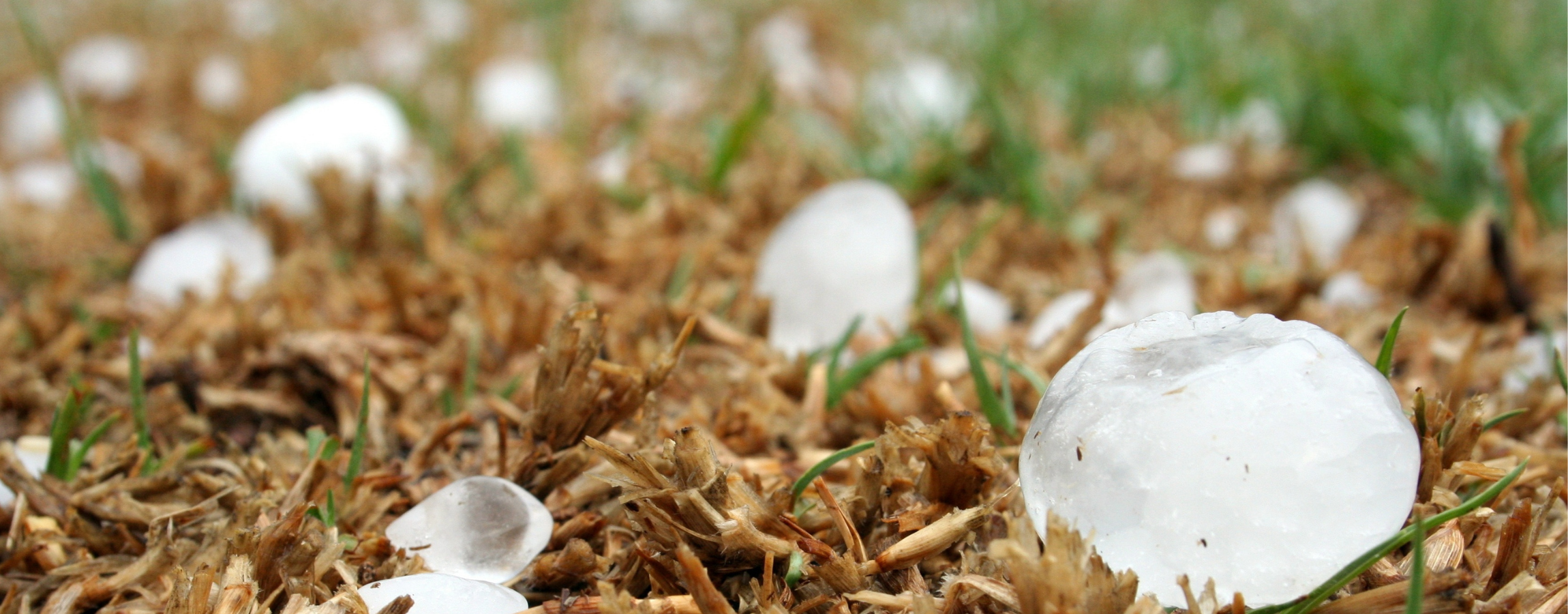
Hail is a form of solid precipitation consisting of ice pellets, which are defined as such when they reach a diameter of approximately five millimetres (Kunz et al. 2017). Hailstones consist of frozen water containing air bubbles and have a rather milky-white, compact and often porous structure (Spektrum n.d.). They can occur individually or as clumped, larger structures and thus differ significantly from sleet, which has a softer consistency (Watzek, J. 2024). How it forms and what this may mean for safety will be examined in more detail below.
Record-breaking Hailstones
The world’s largest hailstone was recorded on 23 July 2010 in Vivian, South Dakota. With a diameter of 20.3 cm, a circumference of 47.3 cm and a weight of approximately 0.88 kg, it was as big as a volleyball. This record-breaking hailstone caused considerable damage to property and is considered the largest officially recorded hailstone in the world (Mobiliar Lab for Natural Risks 2023). The largest hailstone recorded in Germany, found in Undingen, Reutlingen district, on 6 August 2013, had a diameter of 14.1 cm and weighed 0.36 kg, comparable to a large orange (Herold, C. 2021).
How is hail formed?
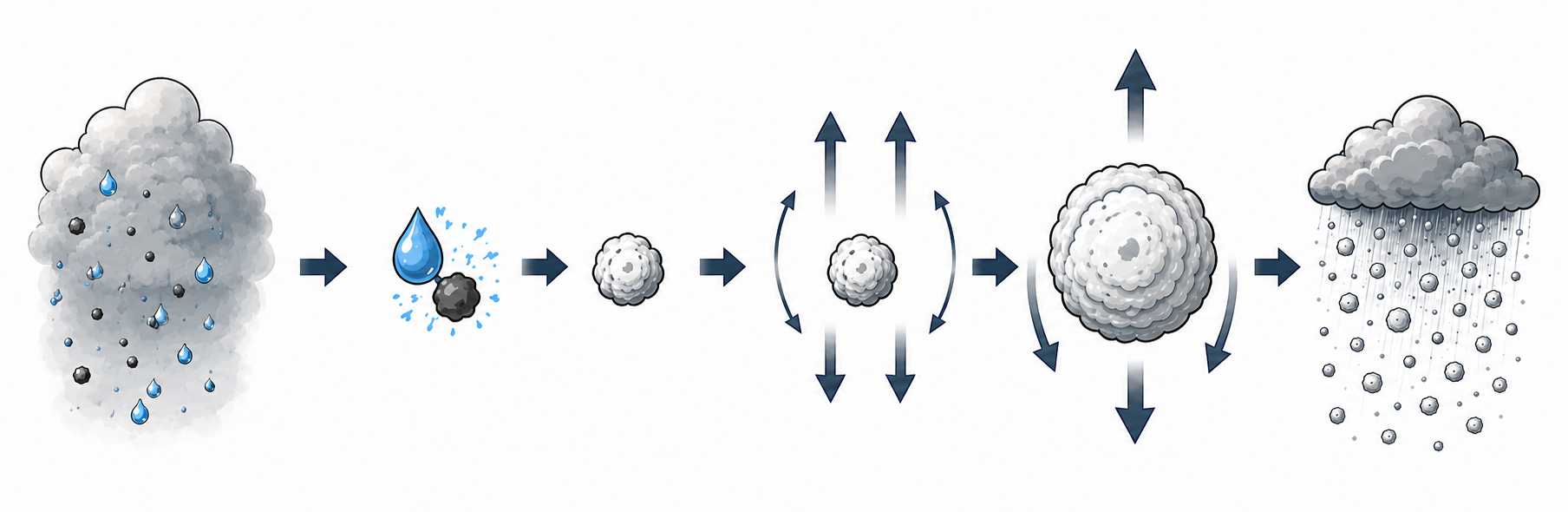
Hail forms in towering thunderclouds (Watzek, J. 2024), where strong updrafts and downdrafts prevail, along with very cold temperatures. These clouds contain numerous supercooled water droplets and ice nuclei, which form the basis for the formation and growth of hailstones.
Hail formation requires temperatures between −10 °C and −30 °C in specific areas of the thundercloud. These areas contain numerous supercooled water droplets, which remain liquid despite temperatures below freezing. Only when they encounter so-called ice nuclei (aerosol particles) do they freeze instantly. This initially produces small sleet particles, which serve as hail embryos. Strong updrafts repeatedly carry these particles upwards, where further water droplets attach themselves and freeze. In this way, the hailstone grows in layers through dry and wet growth (Kunz et al. 2018).
High humidity and strong, persistent updrafts are particularly crucial for the further growth of hailstones. The more water available in the cloud and the stronger the updrafts, the larger the hailstones can become – particularly extreme sizes are often reached in long-lived, rotating thunderstorm cells (supercells) (Mohr, S. 2013).
©AI-generated
Hail distribution and hotspots in Germany
Hail occurs in Germany mainly during the summer months, with a peak between May and August (Kunz & Puskeiler 2010). In principle, it can occur anywhere, but there are regional hotspots – particularly in southern Germany, where hail events are more frequent.
As hail occurs very locally and is rarely measured directly, risk assessments are often based on radar data. This data enables a comprehensive, high-resolution analysis of thunderstorm cells and provides important insights into the distribution of hail.
Long-term trends vary by region: whilst hardly any changes are observed in northern and central Germany, hail activity is increasing in parts of southern Germany due to climate change (Mohr, S. 2013).
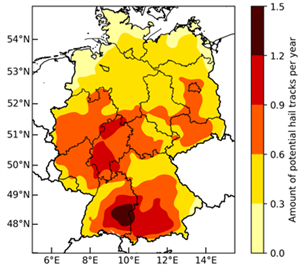
Average number of days with a risk of hail per year (Data: Radar-Data DWD, Timeframe: 2005-2024, Summer months; Source: KIT, 2025)
Temporal and spatial predictability
Challenges
Predicting hail is particularly difficult, as hailstorms often occur only over a small area and last for only a short time. Although numerical weather models use up-to-date weather data and physical calculations, they are sensitive to even the slightest changes in initial conditions. As a result, forecasts can vary and uncertainties can arise (Mohr, 2013).
Possible Solutions
So-called convection parameters are used to better assess the risk of hail (Mohr, 2013). Of particular importance here is CAPE (Convective Available Potential Energy), which describes the energy potential for thunderstorm development. Vertical wind shear also plays a key role, as it can favour the formation of supercells and thus large hailstones (Kunz et al. 2020).
Nowcasting is also used for the short-term monitoring of active thunderstorms. Radar data enables thunderstorm cells to be monitored in real time, and their intensity and direction of movement to be analysed. High radar reflectivity provides indications of potential hail events (Wilbert, L. 2024).
Further challenges relating to hail
Challenges in Research
- Hail climatology cannot be directly derived from weather station data
- Long-term, comprehensive observational data are difficult to collect
- Despite their limited local extent, hail events have so far only been documented in an unreliable manner
- Lack of high-resolution modelling approaches for hail events
- Lack of understanding of atmospheric processes and the influence of climate change
- Accurate analyses of the causes and regional probabilities of hailstorms
- Realistic assessments of risks and potential damage
- Reliable nowcasting
- Reduction of uncertainties in numerical weather models
- Insufficient research relating to hail and solar energy
(Brasseur, G. P. 2017; KIT 2021; Raupach et al. 2021; Fuchs & Kunz 2024)
Operational Challenges
- Determining appropriate times to issue alerts
- Timely and comprehensive warning of the public
- Rapid implementation of appropriate protective measures
- Managing failures of critical infrastructure
- Ensuring sufficient and appropriate operational resources
- Compensating for limited human and material capacities
- Effective coordination of concurrent operational situations
- Minimising damage to agriculture and risks to the food supply
- Relieving the burden on emergency services despite increasing extreme weather events
- Preparation for the difficult-to-predict magnitude and intensity of hailstorms
(BBK 2025)
Destruction of agricultural produce
In agriculture, even small hailstones can lead to a total crop failure, depending on the time of year and the plants’ growth cycle, and particularly when accompanied by strong gusts of wind.
Damage to roofs, façades and solar panels
Damage to roofs in particular can lead to secondary damage, such as water damage caused by heavy rain seeping in.
Risk to human life
In agriculture, even small hailstones can lead to a total crop failure, depending on the time of year and the plants’ growth cycle, and particularly when accompanied by strong gusts of wind.
Damage to vehicles
Vehicle damage is the biggest factor in financial losses and is therefore of particular importance to the insurance industry.
COSTS
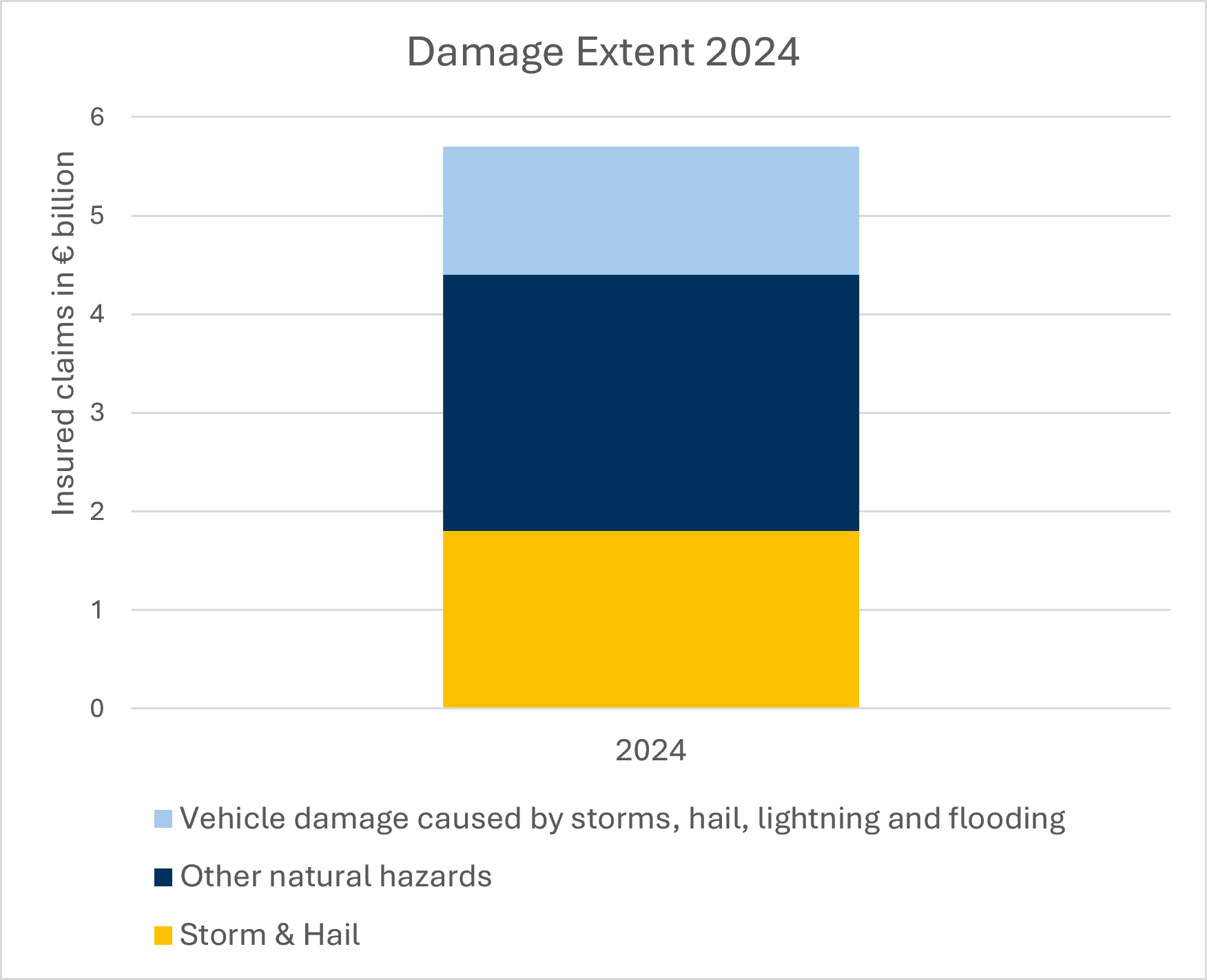
Due to the nature of this damage, hail can cause very significant losses. The extent of the damage varies considerably between the federal states. In extreme years, up to 18 per cent of insured buildings have been affected by storm and hail damage. Often, a single severe storm event is responsible for a large proportion of the damage. In 2024, natural hazards in Germany caused a total of around €5.7 billion in insured losses. Of this, €1.8 billion was attributable to property damage caused by storms and hail, €2.6 billion to property damage caused by other natural hazards, and a full €1.3 billion to damage caused by storms, hail, lightning and flooding in motor insurance. This highlights the fact that the costs of motor vehicle damage are high in comparison to other categories of damage. According to experts, the number of storm-related claims is expected to rise further in the future due to climate change (SDV AG 2023; GDV 2025).
©DKKV
Climate Change
As a result of human-induced climate change, the Earth has already warmed by around 1.1 °C compared to pre-industrial levels (as of 2023). To avoid serious consequences, global warming should be limited to 1.5 °C as far as possible, according to the Paris Agreement. Without rapid reductions in emissions, there is a risk of increasing extreme events such as heatwaves, droughts, storms, heavy rain and flooding (LpB o.J.).
Climate change is increasingly leading to rising temperatures. This means that the atmosphere can hold more moisture, which is an important source of energy for thunderstorms. Studies show that humidity in southern Germany has already risen significantly in recent decades. This results in more frequent high-energy thunderstorm conditions, which can lead to heavy hail. Researchers expect the ratio of smaller to larger hailstones to change in the future. This could mean that smaller hailstones occur less frequently, whilst at the same time the likelihood of larger – and therefore more damaging – hailstones increases. However, the exact development is complex and depends on other factors such as storm types or aerosols in the atmosphere (Fischer & Kunz 2025; .
What is clearer, however, is that heavy rainfall events are on the increase due to the higher moisture content in the air. Thunderstorms are therefore increasingly leading to heavy rainfall, flooding and flash floods. These developments can clearly be attributed to the consequences of man-made climate change (Prochazka, J. 2024).
Precautionary measures
-
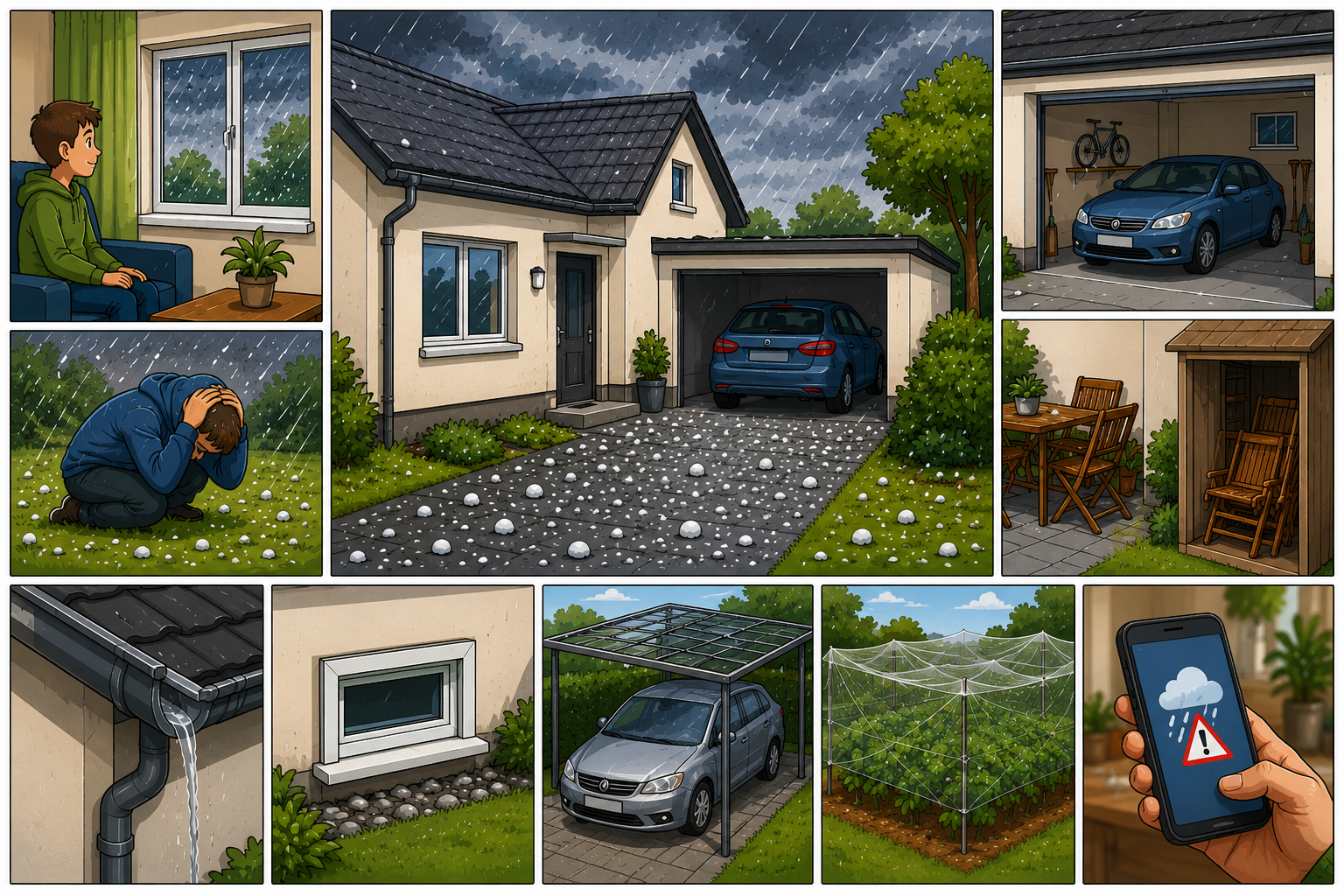
- Seek shelter indoors
- Take cover outdoors: lie face down on the ground or crouch down, and protect your head and neck with your hands, bags or blankets
- Park vehicles in garages or under cover where possible
- Secure loose items such as garden furniture or bicycles in good time
- Clean gutters regularly to ensure rainwater can drain away freely
- Close and seal basement windows to prevent water ingress
- Take hail-resistant materials into account in construction and renovation projects
- Use protective grilles, covers or nets for buildings, vehicles and agricultural land
- Keep a close eye on weather warnings. Alert apps can help with this. (e.g. NINA, KATWARN, etc., you can find more apps on the Storms or Heavy Rain page)
(GDV 2019)
The BBK has compiled further advice and tips on what to do in the event of a disaster here: BBK Planning ahead for crises and disasters.
©AI-generated
Aktuelle Informationen

Cyclone Gezani hits Madagascar hard – THW provides relief supplies
On 10 February 2026, tropical cyclone Gezani hit the east coast of Madagascar with wind speeds of up to 250 kilometres per hour, causing severe devastation. According to official reports, at least 31 people were killed and many more were injured. Several people are...
Series of winter storms causes severe flooding in North Africa and Southern Europe
A series of winter storms has caused severe flooding in Morocco, Spain and Portugal in recent days. People have lost their lives in several regions, hundreds of thousands have been forced to leave their homes, and the damage to infrastructure, agriculture and...