

As part of the Resilient Voices project, two focus group discussions were conducted in Buxtehude in mid-May, each involving eight participants: one with residents of Lebenshilfe Buxtehude and one with participants of a DeuFö B2 language course at the VHS Buxtehude. Participants from both groups expressed a strong interest in becoming more actively involved in disaster preparedness topics and in having their perspectives meaningfully included.
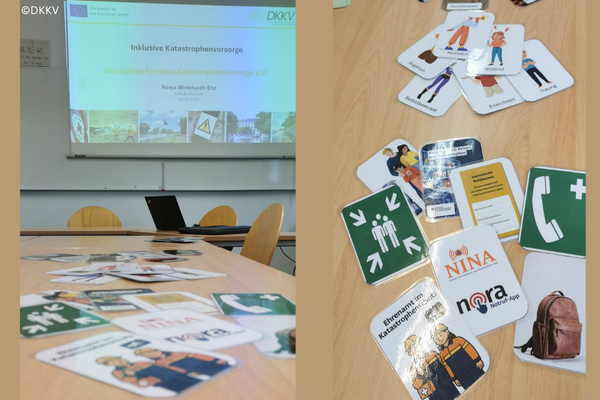
In both focus groups, the new serious game “See. Feel. Act. – An Inclusive Game for Disaster Preparedness” was used. The cooperative game supports discussion in small groups through illustrated cards. Each game round consists of three phases: In the first phase, a card depicting a natural hazard (e.g. storms or flooding) is presented and discussed together (“What do I see? What is happening?”). In the second phase, participants choose cards representing their emotions in response to the situation and explain their choices (“How do I feel about this?”). In the third phase, participants discuss possible solutions by selecting and explaining suitable action cards (“What can I do?”). Participants also have the opportunity to create additional action cards with their own ideas. Afterwards, emotions are re-evaluated in light of the identified coping strategies and possible actions. The game helped participants engage with the topic, encouraged exchange, and made experiences as well as uncertainties visible.
Participants from Lebenshilfe already demonstrated a certain level of prior knowledge and interest in disaster preparedness. Some, for example, were familiar with warning apps such as NINA or expressed interest in organisations like the voluntary fire brigade. Participants identified low-threshold and practical approaches as particularly suitable, including visits to or from the fire brigade, THW, or other emergency organisations, invitations to open days, and integrating the topic into existing leisure and sports activities. The focus group discussion itself already had an activating effect: the residential groups expressed a desire to engage more deeply with preparedness and to make greater use of existing informational materials.
Participants of the language course also contributed important perspectives. In particular, they emphasised the importance of information that is easy to understand and readily accessible. Many participants already had experience with disasters from their countries of origin and described a strong sense of helpfulness and solidarity — highlighting significant potential for strengthening volunteer engagement. At the same time, challenges became apparent, including uncertainty caused by misinformation and a need for better access to first aid training and knowledge. In addition, the topics of war and crises played a major role in participants’ perception of risks.
Across both groups, it became clear that alongside existing challenges, there are also considerable resources — particularly experience, commitment, and a willingness to support others. These potentials can be purposefully built upon in the future to strengthen more inclusive and everyday-oriented disaster preparedness in Buxtehude.
As part of the project, an additional focus group discussion will also explore the perspectives of older adults in need of assistance.
(Image source: DKKV)