

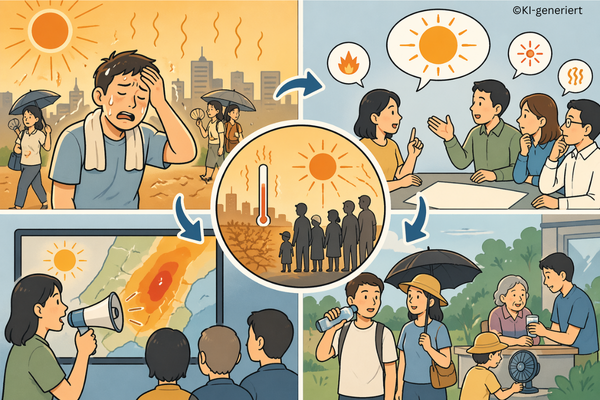
In the face of increasing heatwaves and new temperature records, Japan is breaking new ground in climate communication. A recent study by the University of New South Wales shows how language, perception and public engagement are being specifically used to raise awareness of climate risks and encourage action.
Japan already has an established classification system for hot days: From 25 °C, it is referred to as a ‘summer day’ (Natsubi); from 30 °C, a ‘hot day’ (Manatsubi); and from 35 °C, an ‘extremely hot day’ (Mōshobi). However, there are currently no categories for temperatures above 40 °C – which are now occurring with increasing frequency. This is precisely where a new approach by the Japanese Meteorological Agency comes in: the public is being actively involved in the development of a new term. Terms under discussion include ‘koku’ (painful/agonising), ‘kibishii’ (severe/harsh) and ‘en’ (scorching/blazing), which are intended to convey the danger of extreme heat more effectively.
The article also highlights that direct experience of extreme events does not automatically lead to greater climate action. Perception and willingness to act are strongly shaped by communication, cultural interpretations and individual experiences. Japan’s approach demonstrates how a more participatory and everyday “language of climate” can help make risks more tangible and bridge the gap between knowledge and action.
Read more here.
(Image Source: AI-generated)