

The Umweltbundesamt (German Environment Agency, UBA) has published the updated “Handbook on Environmental Costs – Methodological Convention 4.0”, providing revised environmental cost factors to support evidence-based political and economic decision-making.
According to current modelling, Germany’s greenhouse gas emissions in 2024 will cause global welfare losses of approximately €647 billion over their atmospheric lifetime. These estimates account for damages affecting both present and future generations. The calculations are based on the updated climate damage cost factors presented in the new handbook, combined with preliminary emission data for 2024.
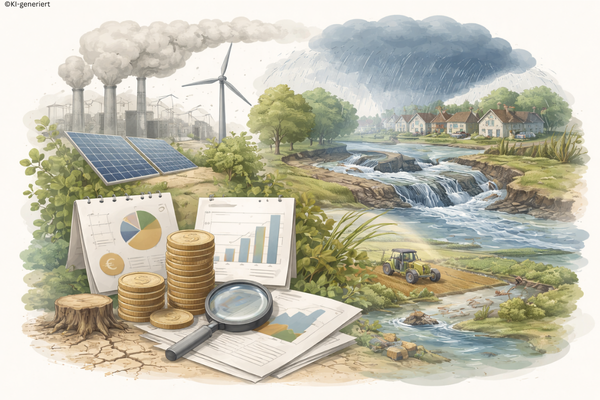
Environmental pressures such as greenhouse gas and air pollutant emissions not only impact ecosystems and the climate but also generate significant economic and health-related damages. These include crop losses due to drought, infrastructure damage from flooding, and respiratory diseases linked to air pollution. By monetising such impacts, the handbook aims to make the scale of damages transparent and comparable, thereby supporting investment decisions, policy design, and sustainability reporting.
In addition to greenhouse gases, the handbook provides updated cost factors for air pollutants, environmental impacts of electricity and heat generation, transport (including noise), nitrogen and phosphorus emissions, and environmental effects in agriculture. The values are based on modelling approaches and represent national average estimates; for local assessments, region-specific data should be used where available.
The updated methodology underlines that ambitious climate action is not only environmentally necessary but also economically prudent: every tonne of greenhouse gases avoided reduces tangible damages to health, infrastructure, prosperity, and economic performance
Further information and the full “Handbook on Environmental Costs – Methodological Convention 4.0” are available here.
(Image source: AI-generated)