

The EU-funded AHEAD project (Advanced Disaster Damage and Loss Data Information System for Enhanced Impact-based Knowledge) is developing an innovative information system for the systematic collection and use of disaster damage and loss data. The aim is to provide an improved, impact-based knowledge base for a wide range of use cases, including compensation mechanisms, the improvement of risk models, and forensic investigations to support “build back better” approaches.
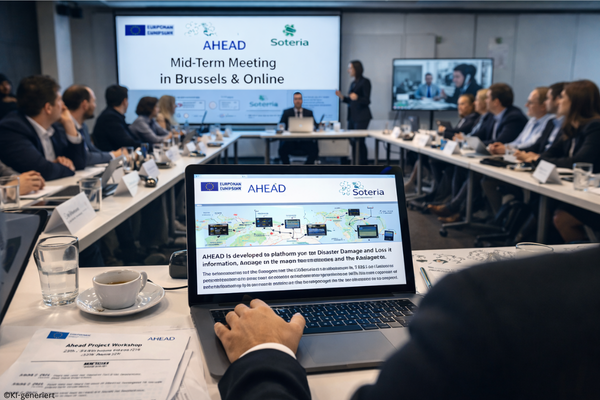
The AHEAD mid-term meeting will take place on 27 and 28 January 2026 in Brussels and online. During a project workshop, interim results from the development, testing and application of the AHEAD information system will be presented and discussed with stakeholders. On the afternoon of 27 January, the focus will be on preliminary results from testing and application, providing insights into the system’s potential, challenges and opportunities for further development.
On 28 January, the programme will be complemented by a joint session with the Horizon Europe project SOTERIA, which explores innovative insurance solutions for climate change adaptation. Both projects share a key focus on how to improve knowledge bases and data collection in order to design more effective and innovative climate adaptation and disaster risk reduction measures. Panels, technical sessions and interactive formats will address topics such as risk and damage assessment, data integration, governance and legal aspects, as well as innovative insurance approaches.
A highlight of the programme is a joint World Café format, which fosters exchange between research, practice, the insurance sector and policy actors. Discussions will cover, among other topics, the use of damage and loss data, the development of IT-based data systems, and concrete use cases for disaster risk reduction and climate change adaptation. The meeting is aimed at stakeholders from science, public authorities, international organisations and practice who are interested in data-driven approaches to disaster preparedness and resilience.
Interested participants are invited to join the meeting online and actively contribute to the discussions. The meeting will take place at the following times: 27 January 2026 from 14:00 to 17:30 CET, and 28 January 2026 from 09:00 to 12:30 CET and from 13:30 to 17:30 CET. You can register here.
You can view the full agenda here.
(Image source: AI-generated)