

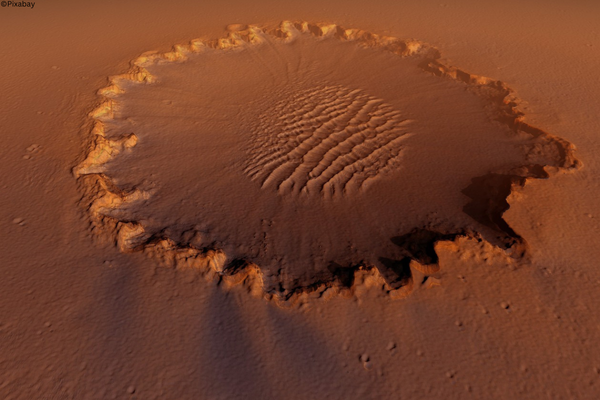
A new video from the Mars Express mission takes viewers on a virtual flight over one of the most striking structures in the southern Martian highlands: the 245-kilometre-wide impact crater Flaugergues.
The animation is based on image data from the High Resolution Stereo Camera (HRSC), which was developed by the German Aerospace Centre (DLR) and has been orbiting the planet on board Mars Express since 2004. High-resolution three-dimensional terrain models are calculated from the HRSC data.
These enable geological processes from the early days of Mars to be reconstructed – a glimpse into an era that can no longer be traced on today’s dynamic Earth. Extensive impact structures such as Flaugergues help researchers to date large parts of the southern Martian highlands to around 3.94 billion years ago.
The virtual flight first takes us over Scylla and Charybdis Scopuli, a depression up to 1,000 metres deep with comparatively few impact craters, and then to the neighbouring Bakhuysen crater. Finally, the focus shifts to Flaugergues itself: its crater floor shows an unusual combination of rugged highland relief and an almost flat surface, indicating that it was previously filled with low-viscosity lava.
The crater is named after the French astronomer Honoré Flaugergues (1755–1835). The video brings the complex geology of this region to life and impressively demonstrates the contribution that HRSC data makes to research into the history of Mars.
The full article can be read here.
(Image source: Pixabay)