

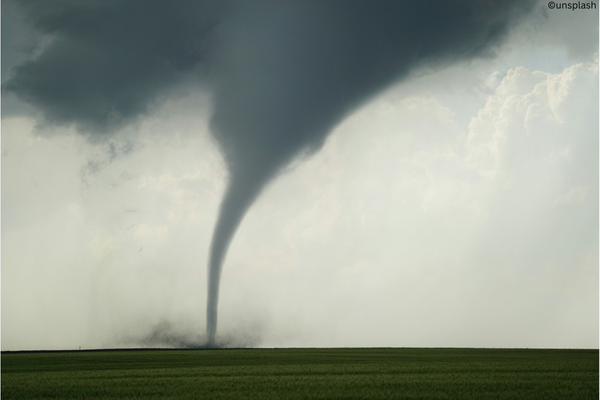
New scientific analyses conducted with the participation of a group of experts from the German Weather Service (DWD) show that tornadoes occur more frequently in Germany than previously assumed. According to these analyses, an average of around 50 confirmed tornadoes are recorded in Germany each year. Previous estimates assumed around 10 to 20 events per year.
The research paper “Tornadoes in Germany: intensity, temporal and spatial distribution” by Marcus Beyer, Kathrin Wapler, and Thilo Kühne is the first systematic analysis of the intensity and temporal and spatial distribution of tornadoes in Germany. The study is based on improved data collection, more intensive evaluation of damage reports, and advances in the observation and documentation of extreme weather events.
Tornadoes are rotating columns of air that touch the ground and can form under storm clouds. Their formation is facilitated by factors such as strong temperature contrasts, rising air masses, and pronounced vertical wind shear. Depending on the environment, they are also referred to as large trombes, whirlwinds, or waterspouts. Wind speeds can reach several hundred kilometers per hour, with damage typically occurring in strips along the path of the tornado.
The Fujita scale is used to classify the intensity of tornadoes, ranging from weak to very strong. The highest intensity levels are rare in Germany, but the results nevertheless illustrate the relevance of the phenomenon for Central Europe.
The new findings contribute to a more realistic assessment of the risks posed by tornadoes and improve our understanding of extreme weather events. In addition to the technical paper, DWD expert Marcus Beyer explains the results in an interview, and Volker Mrasek reports on the latest evaluations on Deutschlandfunk radio.
More information and the full paper can be found here.
(Image Source: unsplash)