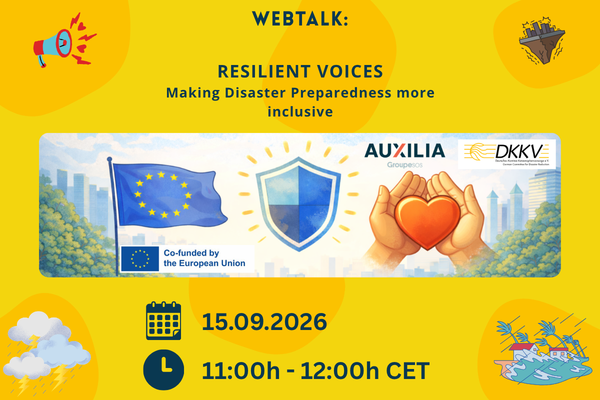
How can risk information be communicated in a way that reaches and is understood by everyone? The Erasmus+ project RESILIENT VOICES addressed this question, and its key findings were presented on September 15, 2026, during an interactive WebTalk.
Extreme weather events such as floods, storms, and heat waves pose growing challenges for local communities and the general public. At the same time, vulnerable groups in particular—including older adults, people with disabilities, and people with a migrant background—continue to face barriers in accessing risk information, taking preventive measures, and participating in disaster preparedness efforts.
During the WebTalk, Ronja Winkhardt-Enz (DKKV) and Elodie Gouhir (Auxilia / Groupe SOS) presented key findings from the project. The findings are based, among other things, on surveys, focus groups, and experiences from pilot municipalities in Germany and France. The study examined how the perspectives of different population groups can be more fully integrated into disaster preparedness and risk communication.
One focus was on accessible and target-group-specific risk communication. In addition, approaches were presented for more effectively involving local stakeholders and affected population groups in preparedness processes. The findings show, among other things, that traditional communication channels do not reach all population groups. At the same time, trusting local relationships can strengthen the willingness to take preventive measures. Even people in vulnerable situations have their own resources and abilities that can contribute to community resilience. It became clear that vulnerability arises from the interplay of various factors and must therefore be viewed in a nuanced manner.
The WebTalk also presented concrete recommendations for inclusive disaster preparedness. These include accessible and target-group-appropriate communication, the early involvement of vulnerable groups, and the use of various information formats and communication channels. Furthermore, the importance of local preparedness drills, cross-sectoral cooperation, and greater involvement of the local population was emphasized. Trust-based neighborhood networks, climate adaptation measures, and the promotion of resilience in everyday life can also help strengthen preparedness at the local level.
The RESILIENT VOICES project is being implemented as part of the Erasmus+ program and is dedicated to better integrating the voices and perspectives of previously underrepresented population groups into disaster preparedness processes.
You can find the recording of the WebTalk here.